Building date: Razed 1909
Original use:
Corner structures:
Mortar application and content:
Types and uses of stones:
Types and choice of windows:
Structures with similar masonry details:
Masons who worked on building:
Unique features:
Map views courtesy Google Maps
Town of Batavia and Genesee County Maps
"Cobblestone Block" on south side of Main Street was razed in 1881. Richard Palmer blog.
Editor's Note: The following hand written note was found in the Cobblestone Museum archives: "Site Cobblestone block in Batavia #63, 67, 69 Main St,, built 1841, reconstructed 1881 and later demolished [circa 1909] with much local complaint reported in press about its loss." This may be a contradiction with other information provided on this page.
One recalls that with regret that today only the site remains of the once famous Cobblestone Block on Batavia's Main Street where was printed the first issue of the Daily News, June 25, 1878. Excerpt from "Cobblestone Examples Noted in Genesee Recall Construction Over Century Ago.
"The Cobblestone Block", Batavia Daily News, 4/17/1909 page 55
"Residents of Batavia 55 Years", Batavia Times, Saturday, March 29, 1919
Dr. Hiland H. Benjamin, who is nearly 84 years of age, of No. 31 Center St., together with his wife came to Batavia 55 years ago Tuesday. In 1868 Dr. Benjamin entered the office of Dr. Nelson Stevens, who was the first dentist in Genesee County. In 1868 Dr. Benjamin opened an office at no. 63 Main St. in the Cobblestone building, but of late years has had his office at his home. Dr. Benjamin was born in Orleans county.
Daily News, Batavia, October 30, 1937
Pictured below is a section of Batavia's Main street of the post-Civil War era. It is the original site of the building on the south side of Main street and Exchange Place, later remodeled and now housing the Carlton M. Sleght and E.J. Beardsley stores and the Western Union offices and office of Allen G. Strong, optometrist.
One of Batavia's Main Street landmarks was the "Cobblestone Building," shown in the 1880's, so named because of the "cobbles" that constituted the face of the structure. [Note: It was razed in 1881]
Indispensable fixtures of the business section of those days were hitching posts that can be seen in the foreground. They were spaced so as to prevent congestion and provide room for team-drawn wagons as well as single-horse carriages.
At the time the picture was taken, Baker and Walkinsaw, operation of a combination bakery and drug establishment, occupied the store adjoining Exchange Place. Next door was Homer N. Kelsey's jewelry store and the third store housed Mackey Brothers' news-room.
On the extreme left is the store occupied by Hewitt Bros. dry goods merchants, the present site of the west half of the Bank of Batavia. On the second floor were the offices of Seth Wakeman and William C. Raton. After the death of Mr. Wakeman, Mr. Watson continued to maintain offices there.
Among the occupants of the upper floors of the "Cobblestone Building" were Knight's Photograph Gallery, D. Hiland H. Benjamin, dentist, Bloomfield's tailor shop and Luckle's tailor shop. For a time The News had offices on the third floor.
The late Daniel W. Tomlinson, father of Everett R. Tomlinson of the Bank of Batavia, bought the building in the 1880's, modernized and partially rebuilt it. Later, the late Postmaster John F. Ryan purchased part of the "Cobblestone Building" block. E.J. Beardsley and Carlton M. M. Sleght, the other stores.
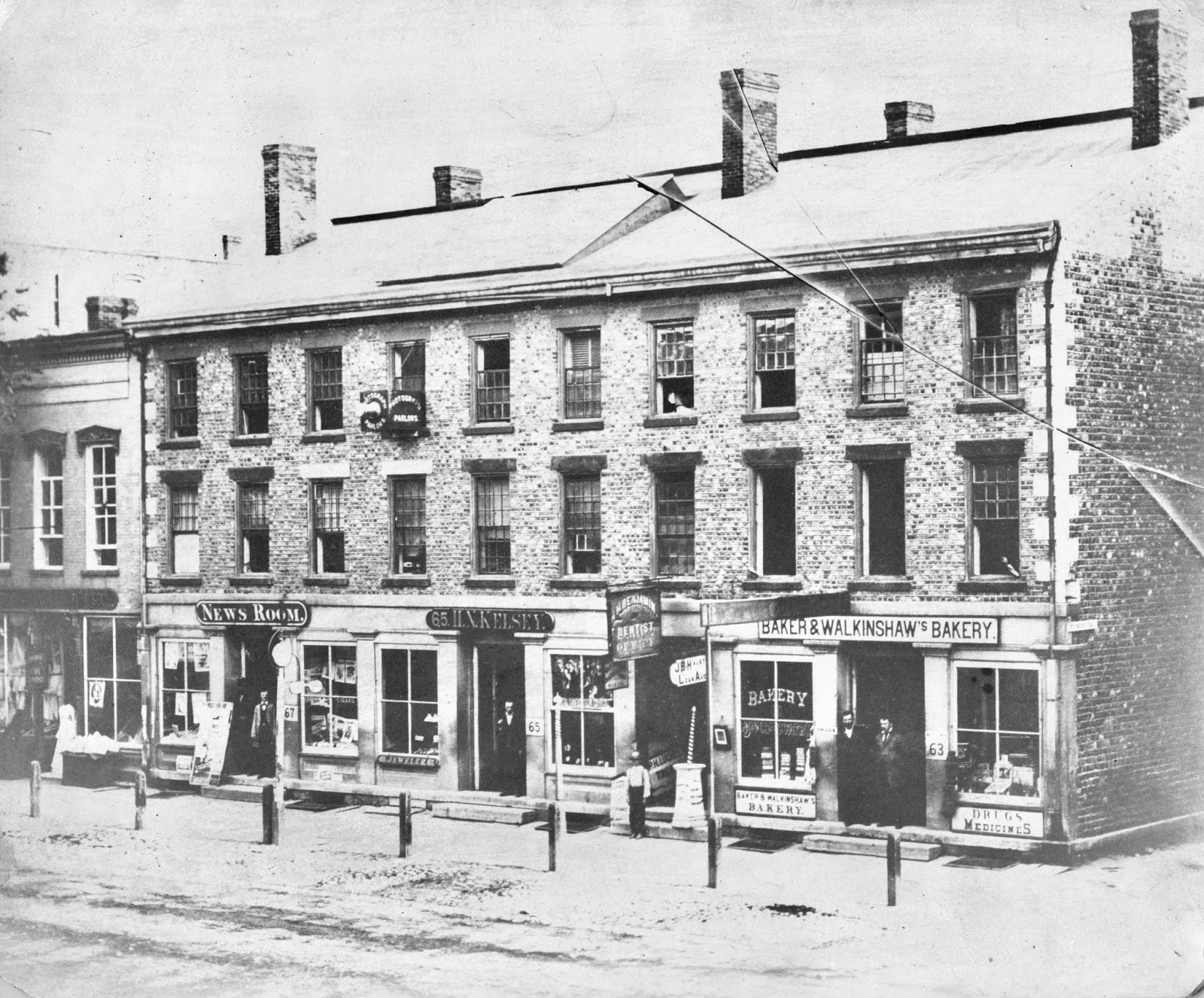 Cobblestone Block, Batavia.jpg. Richard Palmer blog. ¹ |
¹ Photography courtesy Genesee County Historian's office.
